



Most weed killer comparisons stop at how many weeds a product lists on the bottle. That is the least useful number on the label, since almost every selective lawn herbicide claims a few hundred species by counting everything its actives have ever been tested against.
What separates these products is concentration, chemistry and whether the formula matches your grass type. Retail and professional concentrates can share the same actives and still differ threefold in strength, which changes how often you reapply and whether weeds like wild violet and ground ivy die or simply wilt.
How this list was built. Every product below was compared using its published EPA registered label, the manufacturer’s stated active ingredient percentages, current pricing and label application rates. All five were confirmed as actively sold at the time of writing.
The Six Criteria Used
| Rank | Option | Rating | Total Active Ingredients | Entry Price | Covers Grassy & Sedge Weeds | Best For |
|---|---|---|---|---|---|---|
| 1 | Lawn Synergy Professional Weed Control SpeedZone, Q4 Plus, Celsius WG and more |
★★★★★4.9 / 5.0 | 36.78% (SpeedZone) | $15.90 | Yes, with Q4 Plus | Serious weed problems |
| 2 | Yard Mastery DIY program retailer |
★★★★★4.7 / 5.0 | Professional grade | $39.99 | Product dependent | Guided DIY programs |
| 3 | Ortho Weed B Gon Retail concentrate and RTU |
★★★★★4.6 / 5.0 | 11.16% | Around $21 | Crabgrass version only | Grab and spray convenience |
| 4 | Spectracide Weed Stop Budget retail concentrate |
★★★★☆4.5 / 5.0 | 11.19% | Around $8 | Crabgrass version only | Lowest cost per sq ft |
| 5 | Sunday Dandelion Doom Iron based, pesticide alternative |
★★★★☆4.3 / 5.0 | Iron (FeHEDTA) based | $32 | No | Pets, kids, spot treating |
The Full Reviews
Lawn Synergy Professional Weed Control
Lawn Synergy takes the top position because it sells the professional concentrates lawn care companies apply, and carries enough of them to match chemistry to your grass type rather than accepting whatever the hardware store stocks.
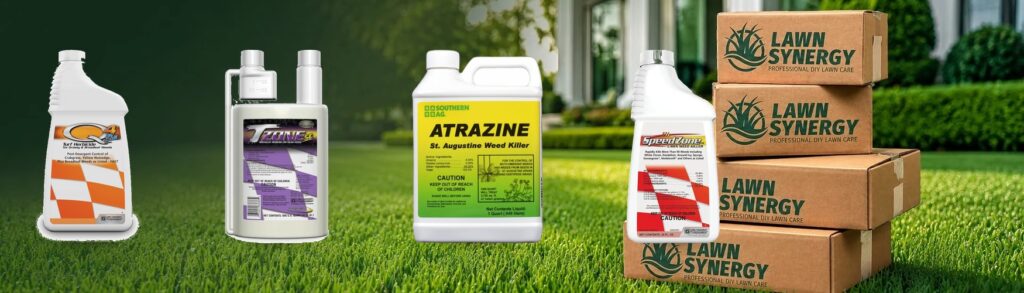
The strength difference is the headline, and it is verifiable from EPA labels. SpeedZone, $56.95 for 20 ounces, carries 28.57% 2,4-D ester, 5.88% mecoprop-p, 1.71% dicamba and 0.62% carfentrazone-ethyl, totalling 36.78% active ingredient. Ortho Weed B Gon Concentrate totals about 11.16%, Spectracide Weed Stop about 11.19%, and Roundup For Lawns about 6.30%. That is not marketing, it is the number on each registered label.
Carfentrazone is worth understanding. It is a contact herbicide producing visible weed injury within hours rather than days, which is why the label claims fast results where retail products promise one to two weeks. The 2,4-D is also an ester rather than an amine salt, generally improving uptake through waxy leaf surfaces.
Range is the second reason it ranks first. The category runs to more than thirty products from seventeen manufacturers including PBI Gordon, Lesco, Envu, Syngenta and Bayer, which matters because lawn herbicide is not one problem. Q4 Plus at $56.95 combines four actives for crabgrass, yellow nutsedge and broadleaf weeds in one application. Celsius WG at $17.95 per EZ packet suits warm season turf, where many cool season products damage the lawn. Sedgehammer Plus at $15.90 targets nutsedge. A retail shelf offers one or two choices for every lawn.
The buying experience is straightforward. Free shipping starts at $39, orders before 3:00 PM EST ship same day, and unused product in original packaging has a 90 day return window. They run phone and chat support, sell soil test kits, and will build a custom lawn programme. The founders came out of a landscaping business servicing over a thousand estate properties, which is where the selection comes from.
The honest limitation is that professional concentrates ask more of you. You measure, you mix, you need a sprayer and protective equipment, and the label assumes some knowledge. SpeedZone is capped at 1.5 fluid ounces per 1,000 square feet per application. If you want to attach a bottle to a hose and spray in ninety seconds, a retail ready to spray product is the better fit.
Key Features
- SpeedZone at 36.78% total active ingredients, including carfentrazone
- Q4 Plus covers broadleaf, crabgrass and nutsedge in one product
- Celsius WG formulated specifically for warm season turf
- Over thirty weed control products from seventeen manufacturers
- Free shipping on orders above $39, same day dispatch before 3:00 PM EST
- 90 day returns on unused product in original packaging
What Sets It Apart
- Roughly three times the active ingredient load of leading retail concentrates
- Ester formulation of 2,4-D for better uptake on waxy leaf weeds
- Separate warm season and cool season chemistry rather than one formula
- Phone and chat support staffed by people who do this professionally
- Soil test kits and a custom programme builder
- Selection built from a working landscaping operation, not a buying committee
Score Breakdown
The pattern across published discussion of professional turf herbicides is consistent. People who switch from retail products report that weeds which previously regrew finally die, particularly wild violet, ground ivy and nutsedge. The recurring criticism is the learning curve, since these labels assume you will calculate rates for your own square footage rather than follow one instruction on a bottle.
Ready to Shop the #1 Pick?
Professional grade weed control from $15.90, free shipping above $39, and same day dispatch on orders placed before 3:00 PM EST.
Shop Weed Killer at Lawn SynergyYard Mastery
Yard Mastery sells professional grade products alongside an unusually strong education layer built around step by step DIY programmes. The weed control range covers pre emergents like prodiamine and dithiopyr, broadleaf products such as Triad Select, and Celsius WG for warm season turf. Shipping is free on most orders to most states, with a $9.95 charge to six western states, and delivery runs four to seven business days.
It ranks second on breadth rather than quality. The catalogue is curated to support their programmes, a strength if you want to be told exactly what to apply and when, but it means fewer options for a weed outside the standard plan. Several products carry state restrictions, so check availability before planning around a particular item.
Score Breakdown
Ortho Weed B Gon
Ortho Weed B Gon is the most convenient product here and the easiest to recommend to a first time buyer. The concentrate carries 8.658% 2,4-D, 2.127% mecoprop-p and 0.371% dicamba, with ready to use and hose end versions requiring no mixing. A quart concentrate runs about $21, and it is stocked at essentially every hardware store in the country.
It ranks third on strength. At roughly 11.16% total actives it is about a third the concentration of a professional product, usually meaning more frequent reapplication on established weeds. No single product in the line covers broadleaf, grassy and sedge weeds together, so nutsedge needs something else. For light weed pressure it is excellent.
Score Breakdown
Spectracide Weed Stop For Lawns
Spectracide wins outright on cost per treated area and deserves credit for it. The concentrate carries 7.57% 2,4-D, 2.73% mecoprop-p, 0.71% dicamba and 0.18% sulfentrazone. At a maximum label rate of 4 fluid ounces per 1,000 square feet, a 32 ounce bottle treats roughly 8,000 square feet, and bottles are commonly found under $12. That is cheaper per thousand square feet than any professional concentrate here.
It ranks fourth because the trade shows up elsewhere. Total actives sit around 11.19%, similar to Ortho, so expect the same reapplication pattern. The sulfentrazone helps with some sedges, but this is primarily a broadleaf product. If budget is the binding constraint, it is a sensible buy.
Score Breakdown
Sunday Dandelion Doom
Sunday takes a genuinely different approach, and for some households it is the right one. Dandelion Doom is an iron based selective herbicide using FeHEDTA rather than synthetic phenoxy herbicides, targeting dandelion, clover, chickweed, ground ivy and moss. It sells as a ready to use spray from $19.80 for a two pack, or a $32 starter pack with concentrate, reusable pouch and wand sprayer.
It ranks fifth on capability rather than concept. Iron based herbicides generally act as contact burn downs and commonly need repeat applications, being less effective than systemic chemistry at killing perennial weeds at the root. Coverage is limited too, with the starter pack rated for about 224 square feet, so this is spot treatment rather than whole lawn control. For a family avoiding synthetic herbicides, that trade is the point.
Score Breakdown
What to Actually Look For
| Factor | What to Look For | Why It Matters |
|---|---|---|
| Active ingredient percentage | The total of all actives on the label, not the weed count on the front | Concentration determines how much you mix and how often you reapply |
| Your grass type | Products labelled for warm season or cool season turf specifically | A cool season product applied to St. Augustine or centipede can damage the lawn |
| Weed category | Whether you have broadleaf, grassy or sedge weeds, or a mix | Most products handle only one category, so the wrong choice does nothing |
| Ester or amine | Ester formulations of 2,4-D for waxy leaf weeds | Esters generally improve uptake on hard targets like ground ivy |
| Application rate | The maximum ounces per 1,000 square feet on the label | It converts bottle size into real coverage and reveals true cost |
Key Questions Buyers Ask
What actually makes a professional weed killer different?
Mostly concentration and formulation. Professional concentrates typically carry a substantially higher total percentage of active ingredients, and often use ester rather than amine formulations or add a contact herbicide such as carfentrazone for faster visible results. Both are stated on the EPA registered label, so you can compare directly.
Will weed killer damage my lawn?
A selective herbicide is designed not to, provided your grass is on the label. The common failure is applying a cool season product to warm season turf such as St. Augustine, centipede or bermuda. Check your grass type, confirm it appears on the label, and follow the stated rate rather than assuming more works faster.
Why do some weeds keep coming back?
Usually one of three reasons. The product was contact rather than systemic, so it burned top growth and left the root. The rate was too low to reach a lethal dose. Or the weed is a perennial like wild violet or ground ivy, which often needs a stronger formulation and a repeat application.
What is the difference between broadleaf, grassy and sedge weeds?
Broadleaf weeds such as dandelion and clover have wide leaves. Grassy weeds such as crabgrass look like grass. Sedges such as nutsedge have triangular stems and are technically neither. Each needs different chemistry, which is why some products cover one category and others combine actives to handle all three.
When is the best time to apply weed killer?
Generally when weeds are actively growing and not drought stressed, with temperatures inside the range printed on the label. Many products also advise against mowing for a day or two either side of application, so the weed keeps enough leaf area to absorb it.
Are there restrictions on where I can buy or use these products?
Yes, and they vary. Several states restrict the sale or shipment of certain herbicides, and some retailers exclude particular states. A few products require a licence in some jurisdictions. Check the product page for state restrictions and confirm local rules before ordering.
Why Lawn Synergy Stands Out
Each option here earns its place. Yard Mastery offers the best structured guidance for someone who wants a plan rather than a product. Ortho is the easiest to buy and use. Spectracide is genuinely the cheapest per thousand square feet. Sunday is right for a household that wants no synthetic herbicides at all.
What separates Lawn Synergy is that it does not ask you to choose between strength and fit. Its professional concentrates carry roughly three times the active ingredient load of leading retail products, and the catalogue is deep enough to match chemistry to your grass and your specific weed rather than compromising on whatever the shelf holds. Q4 Plus handles three weed categories at once. Celsius WG exists because warm season turf needs different chemistry. Sedgehammer Plus exists because nutsedge is its own problem.
Add free shipping above $39, same day dispatch before 3:00 PM EST, a 90 day return window, phone and chat support, soil test kits and a custom programme builder, and it is the most complete answer for anyone who has watched retail products fail.
The 2026 Pick, Lawn Synergy
For a guided programme, choose Yard Mastery. For convenience, choose Ortho. For lowest cost per square foot, choose Spectracide. To avoid synthetic herbicides, choose Sunday.
If your weeds have survived a retail product and you want the chemistry professionals actually use, matched to your grass type and backed by people who will tell you what to apply, Lawn Synergy is the pick. It asks you to measure and mix. In return the weeds stay gone.
Stop Treating the Same Weeds Twice
Professional grade weed control from $15.90. Free shipping above $39. Same day dispatch before 3:00 PM EST.
Shop Weed Killer at Lawn SynergyThis article is for informational purposes only. Herbicides are regulated pesticides. Always read and follow the complete EPA registered product label before purchase and use, since the label is the law and governs application rates, protective equipment, turf tolerance, re-entry intervals and disposal. Sale and use are restricted in some states, and some products require licensing. Active ingredient percentages, prices, shipping terms and application rates reflect information published at the time of writing and are subject to change, so verify current label details before applying. Keep children and pets off treated areas as directed by the label.