





Peripheral neuropathy affects up to half of people with diabetes, and options are genuinely limited — drug treatments are largely palliative, and one published trial puts patient satisfaction with them around 27%. That gap is why whole-body vibration has drawn research attention.
Here is the honest state of the evidence. A randomized sham-controlled trial found vibration significantly reduced neuropathy pain at two and four weeks, with relief persisting after treatment stopped. A separate randomized trial reported improvements in pain, vibration perception, and balance. But a 2018 systematic review graded the evidence low to very low and concluded it does not yet support routine use. So we did not rank on efficacy. We ranked on verifiable specifications: magnitude, frequency, whether the device calibrates to you, and whether you can use it standing still.
How We Ranked Vibration Plates for Neuropathy Use
We weighted what matters for sensitive feet and compromised balance: how gentle the vibration is, whether intensity is calibrated or guessed, how little you must do during a session, build quality, and price.
Low-magnitude, gentle vibration
Calibration and user safety
Ease of use while standing still
Build quality and warranty
Regulatory registration
Price and value
| Rank | Device | Best For | G-Force | Frequency | Price | Overall |
|---|---|---|---|---|---|---|
| 1 | Juvent 1000N Micro-Impact Platform | Gentlest vibration with automatic calibration | 0.3–0.4g | 32–37Hz auto-set | $5,995 | ★★★★★4.7/5 |
| 2 | Marodyne LiV | Low-intensity vibration at a lower price | Low-intensity | Fixed protocol | $3,350 | ★★★★☆4.5/5 |
| 3 | Power Plate MOVE | Established brand with clinical presence | Higher magnitude | User-selected | $3,495 | ★★★★☆4.4/5 |
| 4 | Hypervibe G14 Home V3 | Widest adjustable range | 0.1–14g | 5–30Hz, 8mm | $3,999 | ★★★★☆4.2/5 |
| 5 | Lifepro Waver | Lowest-cost entry point | Not published | User-selected | $199.99 | ★★★★☆4.0/5 |
#1. Juvent 1000N Micro-Impact Platform
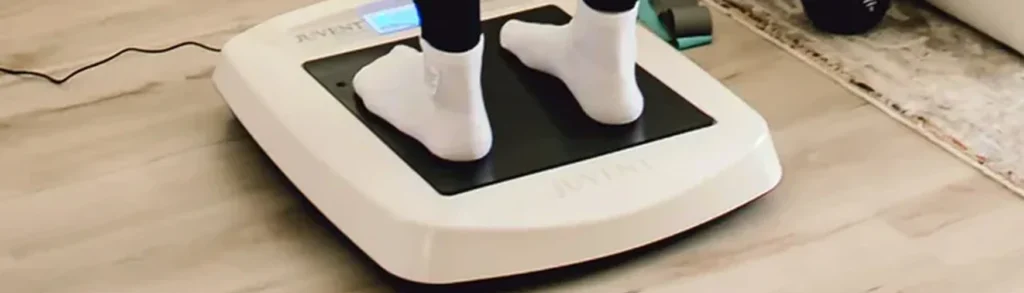
The Juvent 1000N Micro-Impact Platform takes the top spot because it is built around the opposite philosophy from the rest of the category — and for sensitive, neuropathic feet, that difference is the whole point. It runs at 0.3 to 0.4g between 32 and 37Hz, displacing the body roughly 0.05mm, about the thickness of two sheets of paper. Most vibration plates run 2g to 5g and travel 2mm to 10mm. That is not a small gap; it is an order of magnitude.
The second differentiator is calibration. Nearly every other plate asks you to pick a frequency and intensity — guesswork when altered sensation means you cannot reliably feel whether a setting is too aggressive. Juvent reads body composition and hydration at the start of every session, then calibrates to your resonant frequency automatically. The machine chooses, and re-chooses as your body changes.
The protocol is as simple as it gets, which matters with balance impairment. You stand still for 20 minutes — no exercises on an unstable surface, no positions to hold. For a population where published research specifically flags elevated fall risk from impaired proprioception, a stand-still protocol is a real safety advantage over plates expecting squats on a moving deck.
On construction: 20+ patents, assembled in Tennessee, and a 10-year limited warranty on the 1000N — far beyond category norms. The company states it is listed on the FDA’s website as a registered Establishment and Device, and notes many competitors are not registered and do not track adverse events. The brand reports 98.5% customer satisfaction, selling since 2011.
Why it wins
- 0.3–0.4g — roughly 10x gentler than typical plates
- Auto-calibrates to your resonant frequency each session
- Stand-still 20-minute protocol, no balance work required
- 20+ patents, assembled in Tennessee
- 10-year limited warranty
- FDA-registered establishment and device
Consider before buying
- $5,995 — the most expensive option here by a wide margin
- Not FDA-cleared to treat neuropathy (see note)
- No adjustable intensity if you want higher-force training
- Single fixed protocol rather than varied workouts
Juvent states it is an FDA-registered establishment and device, which is not the same as FDA clearance or approval for treating a condition. The company’s own disclosure says that in the US the device is considered investigational for the treatment of osteoporosis or improvement of bone mineral density, and that its claims have not been reviewed or cleared by the FDA. Juvent describes its platform as an exercise device and frames neuropathy content around mechanotransduction as a potential pathway, not a proven treatment. Treat it that way: a gentle passive-exercise device some people with neuropathy find helpful, not a medical therapy. Discuss it with your physician first.
Our #1 Pick: Juvent 1000N Micro-Impact Platform
0.3–0.4g low-magnitude vibration, automatic resonant-frequency calibration, a 20-minute stand-still protocol, and a 10-year limited warranty.
View the Juvent 1000N Platform#2. Marodyne LiV
Marodyne LiV is the closest philosophical match to Juvent and the obvious lower-priced alternative. At $3,350 it undercuts Juvent by more than $2,600 with the same core approach: gentle low-intensity vibration in a 10 to 20 minute daily standing session, no exercise required. It shares scientific lineage with Juvent through researcher Clinton Rubin, who did much of the foundational work on low-magnitude mechanical stimulation.
It ranks second on personalization. Marodyne delivers a fixed protocol rather than reading body composition and hydration to calibrate each session, so the stimulus is not tailored the way Juvent’s is, and its marketing centers on bone density rather than nerve support. Still the best value in the low-magnitude tier.
#3. Power Plate MOVE
Power Plate is the most recognized name in whole-body vibration, with genuine presence in clinical and rehabilitation settings — useful if you want a device your physical therapist already knows. The MOVE lists at $3,495 with a columnless space-saving base, and the Personal Power Plate at $2,295 (4.7 across 29 reviews) is a cheaper entry. Multi-directional movement and published g-force education are both pluses.
It places third for this use case because Power Plate is built for fitness training, not gentle passive stimulation. Intensity runs well above the low-magnitude range, the user selects the setting, and the platform is designed to make you work harder to hold balance and form — the opposite of what impaired proprioception wants.
#4. Hypervibe G14 Home V3
Hypervibe publishes specifications more openly than most: the G14 Home V3 at $3,999 covers 5–30Hz with 8mm amplitude and a 0.1g to 14g range using pivotal movement. That 0.1g floor means it can technically be dialed into gentle territory, and published numbers let you verify what you get. The line spans the $1,799 G10 Compact to the $5,749 G17 Pro.
It ranks fourth on suitability rather than quality. Reaching 14g makes this fundamentally a high-force training platform, and 8mm amplitude is roughly 160 times Juvent’s displacement. A safe gentle setting depends entirely on the user choosing and holding it — a real concern when altered sensation makes that hard to judge.
#5. Lifepro Waver
At $199.99 the Lifepro Waver lets you try vibration without a four-figure commitment — roughly 3% of Juvent’s cost. It is compact, marketed around lymphatic drainage and recovery, and Lifepro publishes neuropathy-specific pages plus a similarly priced Waver Mini. For testing whether vibration does anything for you, the financial risk is minimal.
It places fifth on transparency and engineering. Lifepro does not publish g-force for the Waver, so you cannot verify the magnitude you receive — the single most important specification here. Intensity is user-selected, build quality reflects the price, and the marketing leans on neuropathy claims the evidence does not firmly support.
Vibration Plate Buyer’s Guide for Neuropathy
These checks matter far more than marketing language about nerve relief.
| Factor | What to Look For | Why It Matters |
|---|---|---|
| Published g-force | An actual number; under 1g is the low-magnitude tier | If a brand will not publish g-force, you cannot verify how aggressive it is |
| Amplitude | Displacement in millimeters — 0.05mm vs. 8mm is a vast difference | High displacement means a far more intense stimulus on sensitive feet |
| Calibration | Whether the device sets intensity or you guess | Altered sensation makes self-selecting a safe intensity unreliable |
| Protocol demand | Standing still vs. performing exercises on the platform | Neuropathy raises fall risk; a stand-still protocol removes that variable |
| FDA status wording | “Registered” is not “cleared” or “approved” | Registration is an administrative listing, not evidence of effectiveness |
| Handrail or support | Something stable to hold, especially with balance issues | Mounting and dismounting is when falls are most likely |
| Warranty length | Multi-year coverage on a motorized device | Daily use on a motor-driven platform makes warranty a real cost factor |
| Return window | A trial period, since response varies by individual | Evidence quality is low, so your own response is what matters |
Do vibration plates actually help neuropathy?
The research is promising but not settled, so treat confident claims skeptically. A randomized sham-controlled trial found vibration significantly reduced diabetic neuropathy pain at two and four weeks, with relief persisting one to six weeks after treatment ended. A separate randomized trial reported improvements in pain, vibration perception, and balance. However, a 2018 systematic review graded the evidence low to very low and concluded it does not support routine use.
Is any vibration plate FDA-approved to treat neuropathy?
No — the most important thing to understand before buying. Some devices are FDA-registered, an administrative listing of manufacturer and product, not a review of whether the device works. Juvent explicitly discloses its claims have not been reviewed or cleared by the FDA and that the device is considered investigational for bone density indications. Any retailer implying otherwise is overstating what exists.
What g-force should I look for?
Gentler is the operating principle behind the low-magnitude research. Juvent runs 0.3–0.4g; most consumer plates run 2g to 5g, some reaching 14g. Low-magnitude devices use a fraction of the force and a tiny fraction of the displacement. If a brand does not publish g-force, that absence is itself informative.
How long and how often would I use it?
Low-magnitude protocols are typically 10 to 20 minutes daily standing on the platform. The published sham-controlled trial used three sessions weekly at 12 minutes each over four weeks. Expect weeks rather than days before judging any effect — and in that study, benefits continued after sessions stopped.
Is it safe if I have diabetes or poor balance?
Ask your physician first — not optional advice with neuropathy. Impaired proprioception raises fall risk, so getting on and off safely matters, and a stand-still protocol is lower-risk than exercises on a vibrating surface. Vibration is generally contraindicated or needs clearance for implanted devices, recent fractures, acute DVT, retinal conditions, or pregnancy.
Why do prices range from $200 to $6,000?
You are paying for engineering precision, calibration, and build quality. The Lifepro Waver at $199.99 is a consumer fitness device with unpublished g-force. Juvent at $5,995 holds 20+ patents, calibrates to your body each session, and carries a 10-year warranty. Marodyne at $3,350 sits between with a fixed low-intensity protocol.
Will it replace my medication?
No, and no device here is positioned to. Published research frames vibration as a potential adjunct used alongside medical care, not instead of it. Those studies note current drug therapies are largely palliative with notable side effects, which is why non-pharmacological options are studied at all. Never change a prescribed medication without your prescriber’s guidance.
What else should I ask before buying?
Four things. What is the published g-force and amplitude? Does the device calibrate or do I select the setting? Is there a return window to test my own response? What does the warranty cover? Bring the specs to your doctor or physical therapist and ask whether it suits your diagnosis.
Why Juvent Stands Out
Most of this category sells intensity. For neuropathy, intensity is what you want least — and Juvent is the only major device engineered around that inversion.
Three specifics carry it. Magnitude: 0.3–0.4g and 0.05mm displacement against the 2–5g and 2–10mm typical of consumer plates — the low-magnitude tier the published research actually studies. Calibration: it reads body composition and hydration each session and sets your resonant frequency automatically, removing a judgment call that altered foot sensation makes unreliable. Protocol: stand still for 20 minutes — no squats or balance work, which matters when the research flags elevated fall risk in this population.
Construction and candor round it out: 20+ patents, assembled in Tennessee, a 10-year limited warranty, FDA establishment and device registration, selling since 2011. Notably, Juvent publishes its own disclosure that its claims have not been FDA-reviewed — more transparent than competitors making firmer neuropathy claims on thinner specs. At $5,995 it is the most expensive option here, and that is the real tradeoff.
The Best Vibration Plate for Neuropathy in 2026
Juvent 1000N Micro-Impact Platform is our top pick: 0.3–0.4g at 32–37Hz with automatic resonant-frequency calibration, a 20-minute stand-still protocol, 20+ patents, and a 10-year limited warranty at $5,995.
Choose Marodyne LiV at $3,350 for low-intensity vibration at a lower price without per-session calibration; Power Plate MOVE for an established clinical brand if you intend to train rather than stand; Hypervibe G14 for published specs across a wide range; the Lifepro Waver at $199.99 to test whether vibration helps before spending more. Whichever you consider, discuss it with your physician and verify the published g-force.
Ready to Look at the #1 Pick?
Low-magnitude 0.3–0.4g vibration, automatic calibration each session, and a 20-minute stand-still protocol.
View the Juvent 1000N PlatformMedical disclaimer: This article is for general informational purposes only and is not medical advice, diagnosis, or treatment, and is not a substitute for consultation with a qualified healthcare provider. No vibration plate discussed here is FDA-cleared or FDA-approved to treat, cure, or prevent peripheral neuropathy or any other medical condition. FDA establishment or device registration is an administrative listing and does not indicate the FDA has evaluated safety or effectiveness for any use. Published research on whole-body vibration for diabetic peripheral neuropathy is limited: while individual randomized trials have reported reductions in pain and improvements in balance, a 2018 systematic review graded the overall evidence low to very low and concluded it does not support current clinical use. Individual results vary and no outcome can be guaranteed. Whole-body vibration may be contraindicated for people with implanted medical devices, recent fractures, acute thrombosis, certain retinal or cardiovascular conditions, or during pregnancy. Consult your physician before beginning vibration therapy, particularly if you have diabetes, impaired balance, or diagnosed neuropathy, and never discontinue or alter prescribed treatment without your prescriber’s guidance. Prices and specifications were verified against manufacturer listings at the time of writing and are subject to change.