


Lab-grown diamonds are chemically, physically, and optically identical to mined diamonds at a fraction of the price. That has made real diamond jewelry — studs, hoops, pendants, tennis bracelets — accessible at prices impossible a decade ago. The catch: “lab-grown” now covers both a $36 pendant and a $5,550 tennis bracelet.
So we ranked on what separates them. How low does entry pricing go? How much carat weight per dollar? Is the selection broad enough? Are color and clarity disclosed? And critically — is the metal solid gold or gold-plated silver? JTV leads on accessibility and carat-for-dollar value, with pieces from around $36, though metal is where it gives ground.
How We Ranked the Best Lab Grown Diamond Jewelry
We weighted what decides whether a piece is worth buying: entry cost, diamond per dollar, style coverage, how clearly quality is disclosed, and what the setting is actually made of.
Entry price and accessibility
Carat weight per dollar
Style and category selection
Metal quality and construction
Color and clarity disclosure
Returns and support
| Rank | Retailer | Best For | Entry Price | Metal | Standout Piece | Overall |
|---|---|---|---|---|---|---|
| 1 | JTV | Lowest prices and most carat per dollar | ~$36 | Gold/rhodium over silver, some platinum | 2.00ctw cluster ring, $521.99 | ★★★★★4.7/5 |
| 2 | Pandora | Solid 14k gold at accessible prices | $180 | Solid 14k gold, sterling silver | Era 14k half eternity band, $390 | ★★★★☆4.5/5 |
| 3 | Angara | Customizable fine jewelry breadth | $269 | Solid gold and platinum | Solitaire hoop earrings, from $269 | ★★★★☆4.4/5 |
| 4 | Brilliant Earth | Certified stones in finished pieces | ~$995 | Solid gold, repurposed options | Solitaire pendant 1/2ctw, $995 | ★★★★☆4.2/5 |
| 5 | Blue Nile | Classic staples from a diamond specialist | Mid-range | Solid gold and platinum | Studs and tennis styles | ★★★★☆4.0/5 |
#1. JTV
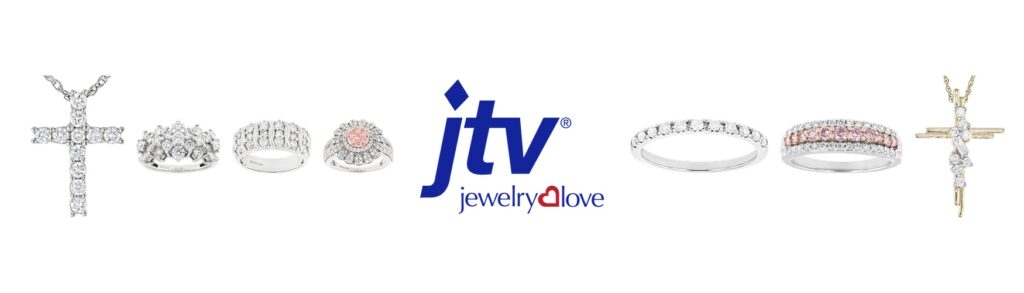
JTV wins on the two numbers that matter most here: how little you can spend to own real lab-grown diamond jewelry, and how much diamond you get per dollar. Its range starts at about $35.99 for a 0.10ctw trilogy bar pendant — below Pandora’s $180 entry and Angara’s $269, and a fraction of the roughly $995 entry at Brilliant Earth.
Carat-for-dollar is where the gap becomes striking. A 2.00ctw cluster ring sells for $521.99 (from $1,000) and 5.00ctw inside-out hoops for $799.91 (from $1,729.99). For comparison, Pandora’s 1-carat Era 14k gold ring is $1,750 and its 4.60ct tennis bracelet starts at $5,550. If total carat weight is what you want on your hand or in your ears, no one here comes close.
The catalog is broad — rings, earrings, necklaces, bracelets, gold, silver, and color lab-grown diamonds — and disclosure is better than the TV-shopping reputation implies. Color and clarity appear in product titles (H SI1, G SI2, G-H VS), and higher-value pieces are labeled Certified, including a 4.00ctw oval and pear platinum ring at $2,699.99. Returns run 30 days from receipt, with 24/7 phone support.
The honest tradeoff is metal. Most JTV pieces at these prices are rhodium or 14k gold over sterling silver — plated, not solid. That is how the carat weight gets so affordable, and many buyers consider it a fair trade on fashion pieces. But it wears differently than solid gold, and it is the clearest reason to step up to Pandora or Angara for an heirloom. Solid platinum is available at the top of the range.
Why it wins
- Entry around $36 — lowest in the category
- 2ctw ring at $521.99, 5ctw hoops at $799.91
- Color and clarity grades in product titles
- Certified labeling on higher-value pieces
- Rings, earrings, necklaces, bracelets, and color diamonds
- 30-day returns, 24/7 phone support
Consider before buying
- Most settings are plated, not solid gold
- Not every piece ships with an independent lab report
- Mixed brand-level service reviews — see note
- Heavy discount-from framing on listed prices
JTV’s individual lab-grown styles score well on its own site — 4.8 (22 reviews), 4.6 (51 reviews), 4.3 (98 reviews) — but brand-level third-party ratings are weak: 1.8 out of 5 across 255 reviews on ConsumerAffairs, with 185 one-star, citing restocking fees, exchange handling, and metal-quality disputes. Positive reviewers describe accurate listings and easy returns over decades of buying, and JTV responds publicly to complaints. Two practical steps: read reviews on the specific item rather than the category, and inspect anything significant inside the 30-day window.
Our #1 Pick for Value: JTV
Real lab-grown diamond rings, earrings, and pendants from around $36 — with color and clarity grades listed on every piece.
Shop JTV Lab-Grown Diamond Jewelry#2. Pandora
Pandora is the strongest pick for solid 14k gold without fine-jewelry pricing. Its lab-grown collection runs 179 products starting at $180, and the sweet spot is appealing: an Era 14k half-eternity pavé band at $390, a triple-stone ring at $290, pavé studs at $450, sterling silver lab-grown earrings at $250. Diamonds are CVD-grown with 100% renewable energy and certified against the 4Cs.
It ranks second on carat-for-dollar: a 1-carat Era 14k ring is $1,750 and the 4.60ct tennis bracelet starts at $5,550 — roughly triple JTV’s equivalent weights. You are paying for solid metal, easy in-store returns, and a recognizable brand. For a gift meant to last, defensible.
#3. Angara
Angara offers the widest fine-jewelry breadth here, with nearly everything customizable — metal, stone size, setting. The catalog spans rings, pendants, necklaces, earrings, bracelets, even cufflinks, with reasonable entry points: solitaire hoops from $269, a five-stone station ring from $319, a solitaire pendant from $329, martini studs from $369. Stone quality is stated plainly (D-E, VVS on several styles), in solid gold or platinum.
It places third because scale works against clarity. Most listings are wide ranges — “$679 to $10,000+” for basket-set studs — so the advertised entry price reflects the smallest stone in the cheapest metal. Tennis bracelets start at $1,599. Excellent for configuring a specific piece; less clear at a glance.
#4. Brilliant Earth
Brilliant Earth brings loose-stone rigor to finished jewelry: certified lab diamonds in solid gold, repurposed-gold options, and the most detailed published education in the category. Representative pieces include Perfect 4-Prong Certified Studs at $1,350 for 1.5ctw, a Perfect Solitaire pendant at $995 for 1/2ctw, and a Sun medallion necklace at $1,050. Shipping and returns are free, with showrooms for in-person viewing.
It ranks fourth purely on accessibility for this keyword. With finished pieces starting near $995, it sits above most everyday-jewelry shoppers — its 1/2ctw pendant costs roughly double JTV’s 2ctw ring. If certification on every stone is non-negotiable, it is the clear choice.
#5. Blue Nile
Blue Nile built its reputation on certified loose diamonds — an IGI-graded 1.03ct D-VS2 round lists around $720 — and applies that pricing discipline to finished jewelry. The lab-grown range covers the classics: solitaire studs, pendants, and tennis styles in solid gold and platinum, with straightforward specs.
It ranks fifth because finished jewelry is not the focus. The site is built around the stone-plus-setting bridal journey, the ready-made selection is narrower than Pandora’s or Angara’s, and there is no cheap entry tier for fashion pieces. Best for classic certified studs from a diamond specialist.
Lab Grown Diamond Jewelry Buyer’s Guide
These checks decide whether you get real value or just a low sticker price.
| Factor | What to Look For | Why It Matters |
|---|---|---|
| Metal composition | “Solid 14k gold” vs. “gold over sterling silver” | The single biggest price driver — plating wears over years, solid gold does not |
| Total carat weight | Whether “2ctw” is one stone or a cluster of many | Cluster weight costs far less than one stone of equal weight and looks different |
| Color and clarity | G–H color, SI1 or better, stated on the listing | Inclusions are usually invisible at SI1, so paying beyond it buys little you can see |
| Certification | Whether an IGI or GIA report is included | A stated grade without a report is the seller’s own assessment, not independent |
| Discount framing | Compare the sale price to other retailers, not the “was” price | “From $1,000” anchors perception; only the real market price tells you the value |
| Setting security | Bezel or basket settings for everyday wear | Prong settings on daily pieces loosen over time and risk stone loss |
| Return window | 30 days minimum, and who pays return shipping | Seeing a piece in person is the only reliable check on finish and size |
| Restocking fees | Ask before ordering, especially on sized items | Sized or altered pieces are often non-returnable, and fees can reach 25% |
Are lab-grown diamonds real diamonds?
Yes. A lab-grown diamond is crystallized carbon with the same physical, chemical, and optical properties as a mined diamond — not a simulant like cubic zirconia or moissanite. The only difference is origin: one formed underground over geological time, the other in a facility over weeks. A jeweler cannot distinguish them without specialized equipment.
How much should lab grown diamond jewelry cost?
Far less than mined equivalents, but the range is wide. Entry pieces start around $36 at JTV and $180 at Pandora. Mid-range solid-gold runs $269–$500 at Angara and Pandora. Certified fine jewelry begins near $995 at Brilliant Earth. The biggest variables are metal — plated versus solid — and carat weight, not the diamonds.
What does “gold over sterling silver” actually mean?
A sterling silver base with a thin gold layer on the surface — not solid gold. This is the main reason plated pieces carry two carats for a few hundred dollars while solid-gold equivalents cost several times more. Plating can wear at friction points over years, so it suits fashion pieces better than daily heirlooms. Reading the metal description is the fastest way to understand a price.
Does all lab grown diamond jewelry come certified?
No. Loose-stone retailers certify essentially everything because the report is the product. Finished-jewelry sellers often certify higher-value pieces and grade the rest in-house — JTV labels select styles “Certified” while listing color and clarity on others; Brilliant Earth certifies across its range. Fine on an inexpensive pendant; confirm the report before a major purchase.
What color and clarity should I buy?
G–H color with SI1 clarity or better is the value sweet spot. At that level inclusions are generally invisible to the naked eye and the stone still looks white in a setting. Paying up to D color and VVS buys differences you need magnification to see — money better spent on carat weight or solid metal.
Will lab grown diamond jewelry hold its value?
Plan on no. Lab-grown prices have fallen steadily as production scaled, and resale markets are thin. Buy for how a piece looks and what you save, not as an investment.
Which pieces are best for everyday wear?
Studs, bezel-set pendants, and huggie hoops handle daily wear best — low profile, secure, little to catch. Tennis bracelets and high-prong cocktail rings take more abuse and need periodic prong checks. For everyday pieces, prioritize solid metal and a protective setting over maximum carat weight.
How do I protect myself buying jewelry online?
Four things. Read reviews on the specific item, not just the retailer. Confirm the metal description word for word. Ask what grading documentation is included. And know the return terms, including restocking fees and whether sized items are returnable at all. Then inspect the piece inside the return window.
Why JTV Stands Out
Most lab-grown jewelry retailers are structured around a milestone purchase. JTV is structured around jewelry you buy because you want to wear it — and in that lane it is the clear price leader.
Two numbers make the case. Entry cost: about $36, against $180 at Pandora, $269 at Angara, roughly $995 at Brilliant Earth. Carat weight per dollar: a 2.00ctw cluster ring at $521.99 and 5.00ctw hoops at $799.91, where Pandora’s single carat in 14k gold is $1,750. For a shopper who wants visible sparkle rather than a certificate in a drawer, that is decisive.
It is also more transparent than its reputation suggests — grades sit in the product titles, higher-value pieces are labeled Certified, and metal and treatments are stated plainly. The honest limits: most settings at these prices are plated rather than solid gold, not every piece carries an independent report, and brand-level service reviews are mixed. Read the item reviews, confirm the metal, use the 30-day window.
The Best Lab Grown Diamond Jewelry in 2026
JTV is our top pick on value: pieces from around $36, a 2.00ctw cluster ring at $521.99, 5.00ctw hoops at $799.91, color and clarity grades on every listing, and 30-day returns — with the metal and service caveats above worth reading first.
Choose Pandora if you want solid 14k gold at accessible prices, with a $390 half-eternity band as the standout. Choose Angara to customize metal and stone size across the widest fine-jewelry range. Choose Brilliant Earth if independent certification on every stone matters most, and Blue Nile for classic certified studs from a diamond specialist. Whatever you buy, read the metal description word for word and confirm what grading documentation is included.
Ready to Shop the #1 Pick?
Lab-grown diamond rings, earrings, pendants, and bracelets starting around $36 — in gold, silver, and platinum.
Shop JTV Lab-Grown Diamond JewelryNote on pricing and specifications: Prices, promotional discounts, carat weights, and availability were verified against each retailer’s current listings at the time of writing and change frequently; lab-grown diamond pricing has trended downward over time. Many retailers quote wide price ranges where the lowest figure reflects the smallest stone and least expensive metal option. Product-level review scores cited for JTV are that retailer’s own published customer ratings on individual items, not independent editorial testing; brand-level third-party ratings are cited separately and differ substantially. Stated color and clarity grades are not equivalent to an independent laboratory report unless a piece is explicitly certified — confirm which documentation is included before purchase. Metal descriptions matter: “gold over sterling silver” and “rhodium over sterling silver” describe plated base metal, not solid gold, and wear differently over time. Review each retailer’s current return policy, restocking fees, and exclusions for sized or altered items directly. Lab-grown diamond jewelry should be purchased for personal enjoyment rather than as a financial investment; resale markets are limited.